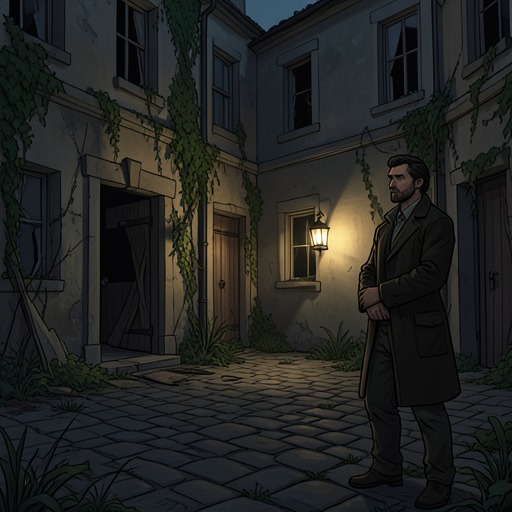
Ce sont les murmures qui m’ont tué.
Pedro Páramo“Ce sont les murmures qui m’ont tué.” (“The whispers killed me.”) is Juan Preciado’s stark explanation for his death in Comala. Repeated as he speaks with Dorotea after his burial, the phrase names not a single voice or visible assailant but a sound that gathers around him until fear becomes fatal.
The Phrase and Its Dispute
Dorotea first challenges Juan’s account that he died for lack of air. She says she found him on the plaza, far from Donis’s house, already stiff and twisted like someone who had died of fright. She and Donis dragged him into the shade of a portico and buried him; in her view, the fact that they could carry and bury him contradicts his explanation about the air.
Juan accepts her correction about where she found him, then insists on a different cause: “Ce sont les murmures qui m’ont tué.” The exchange sets physical evidence against the dead man’s account of his experience. Dorotea can recount his body and what she and Donis did with it; Juan describes the fear and sounds that, to him, explain why it stopped living.
How the Murmurs Become Fatal
Juan says that too many fears had accumulated for him to bear. When he confronted the murmurs, his nerves gave way. At first, he believed a crowd had gathered on the plaza and that being among people might disperse his fear. He moved along the walls, leaning against them as though walking on his hands, and heard voices seep through their cracks and peeling surfaces. The voices were human but muffled, passing him in indistinct whispers; when he moved away from the walls, he still heard them ahead and behind, as if they accompanied him.
The fear also takes bodily form. After leaving the house of a woman who had lent him her bed, Juan feels cold rather than hot. The cold intensifies as he walks, raising gooseflesh; when he turns back in search of warmth, he realizes that it comes from within him, “from my blood,” and understands that he is afraid. The murmurs do not merely frighten him from outside: the account joins the sound to a bodily chill that Juan experiences as his own.
The Empty Plaza and the Voices
Juan reaches the plaza and leans against one of the portico pillars. Although he sees no one, he continues to hear what sounds like the hubbub of a multitude on market day. He compares the steady, senseless noise to wind murmuring in the branches of a tree that cannot be seen. The expected crowd is absent, but the sound remains; the gap between what he sees and hears leaves him without the reassurance he had sought among people.
The noise seems to gather like a swarm, approach, and circle him. Within it, Juan can make out a few words, almost without sound: “Prie pour nous” (“Pray for us”). He says that his soul froze, and connects that moment to Dorotea and Donis finding him dead. The plea gives the murmurs a human and supplicating quality, while their near-inaudibility makes them difficult to locate or answer.
Repetition and Meaning
The sentence returns after Juan’s first assertion, now followed by his fuller account of the plaza, the false crowd, and the prayer. That repetition turns a blunt explanation into testimony: Dorotea questions the physical cause, and Juan answers by reconstructing what fear and sound meant to him. The phrase also condenses the scene’s central contradiction. The plaza is empty, yet crowded by voices; Juan is dead, yet able to narrate the experience; and the burial confirms a bodily death without resolving the cause as he understands it. In this exchange, the murmurs are both the sound he hears and the name he gives to the fear that overwhelms him.